




Jillian's Guide to Black Holes: Forming - Types - Outside - Inside - Finding - References - Websites
Definitions
A black hole isn't really a hole in the universe. The name was coined by Dr. John Archibold Wheeler to describe an object which didn't emit light (hence "black") and from which nothing could escape (like something into a deep hole). It's an object that is so dense that even a photon traveling at the speed of light (as photons do) can't escape from the surface. Actually, the formal way of saying this is that, if you can take something and squish it so that it's small enough, it will form a black hole. How small? Well, the exact size depends on the mass of the object you're squishing and is called the Schwarzschild Radius ("swar shild"), and it is extremely small. (Schwarzschild Radius is a long name that I'm likely to mis-spell at some point, so I'll abbreviate as Rs.)
Black Hole Supernova
It takes a lot of force to squish something smaller than its Rs. We can't do this on Earth, but one way is by the death of a massive star in a supernova explosion. Stars can be thought of as large balloons of gas and plasma: gravity wants them to collapse but they stay "inflated" because their centers are hot. Their centers are hot because material is dense enough and high pressure enough to undergo nuclear fusion. However, at the end of a star's lifetime, it runs out of fuel in the center, the nuclear furnace turns off, and it can no longer support itself. A very massive star which "dies" does so dramatically! The outer layers are no longer "inflated" by the heat from the nuclear furnace, so they collapse onto the core. The core was a dense ball of very hot iron, but it gets compressed by the atomsphere "falling" onto it. A few things can happen at this point, only one of which wil lead to the creation of a black hole.
If the core (the "remnant") is between 1.44 and about 3-ish times the mass of the Sun, it will compress into something called a neutron star. How? The pressure from the atmosphere "falling" onto the core forces the protons and electrons in the core to be squished together to form neutrons. Neutrons, however, don't like to be too near each other and they absolutely hate being right on top of each other, so they resist it. This resistance is a kind of pressure to prevent gravity from making the remnant collapse any further. What you would get is a very hot small (city-sized) sphere with the density of an atomic nucleus. The sphere would be made of neutrons but there might also a thin film of electrons and other stuff at its surface.
If the remnant is more massive than 3-ish times the mass of the Sun, the pressure from the neutrons simply isn't enough to counter the force of gravity, and the object continues collapsing. Eventually it becomes smaller than its Rs, an event horizon forms around it (the "surface" of the black hole), and it is a black hole. What's an event horizon? Check out the different types of black holes to find out!
The upper limit on the mass of a neutron star is not well known, which is why all I can say is "3-ish". The exact value depends on how the neutrons actually behave in the bizarre environment inside a neutron star. Astronomers and physicists have a few ideas about what might happen, but they don't quite know which one is correct; so they don't quite know the precise details of what goes on inside a neutron star and they don't quite know the precise upper limit on the mass of a neutron star.
If you were to watch a star becoming a black hole, you would first see the dramatic and wonderful supernova, in which the star forcefully ejects most of its atmosphere very quickly. It's a violent process but quite pretty. After enjoying this for a while, you would see the star itself start to collapse. After watching this for a while, you would think it mighty peculiar that the star seems to be slowing down and getting redder and dimmer as it collapses. What's all this?! These are the effects of the gravitational field getting stronger. How does that work?
Gravity and Light
You've probably heard that light travels at a constant (very fast) speed in a vacuum. Suppose you have a light ray in a gravitational field (hey, happens every day!). It can't slow down like your watch and your brain and your cells and your atoms because it's light in a vacuum and it must go a constant speed. So, does it just keep going regardless of gravity? No way! The speed of the light ray can't decrease, but the frequency/wavelength/color can. If a yellow light ray tries to climb out of a very strong gravitational field, it loses energy, its frequency will lower, its color will appear to redden. This process is called gravitational redshifting. However, it all depends on the strength of gravity.
Imagine the light rays being emitted from the poor doomed dying star. As the star collapses and approaches its Rs, the gravitational field gets stronger because there is more matter in a smaller place. The light cone becomes narrower and certain light rays (such as those shot out in a tangent to the star) will be bent by gravity to orbit and eventually fall back down. What photons do escape have lost energy by fighting gravity and so have a longer wavelength. Perhaps the remnant will no longer emit light with wavelengths shorter than X-ray light, and then UV light, and then visual light, and then nothing shorter than infrared light. When the remnant is very close to Rs, the light cone is quite narrow, and only those light rays that travel out almost perpendicular to the star's surface will escape the gravitational field. At this point the remnant might not emit any kind of light with a wavelength shorter than microwave light, then nothing shorter than radio light. When the remnant reaches Rs, the light cone closes, the event horizon forms, and light can no longer escape.
Does the black hole just stay that size forever?
No way! The black hole has a certain mass and size of its event horizon when it forms, but that changes over time. If stuff falls into the black hole like dust and light, its mass increases. If its mass increases, its Rs gets a little larger. Therefore, if stuff falls in, the event horizon gets a bigger. The idea that black holes could only get larger feels weird to me, so I'm quite happy to say that there is also a reverse process, where the black hole gets smaller. It has to do with Hawking radiation. In short it is possible for particles to form by stealing energy from the black hole. If the black hole loses energy (and energy = (mass)c2!), it gets smaller. Black holes are rather dynamic in that sense; you can always add charge to them, take charge away, make them rotate slower, and change their size.
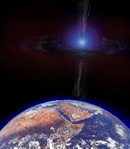 Should the sun become a black hole, the Earth would not immediately plunge toward it. |
Should the sun become a black hole, the Earth would not immediately plunge toward it. BTW, if the sun were to suddenly pop into a black hole (no, it can't actually ever be a black hole, but just imagine), would the Earth go plummeting into it? No, it would continue on its orbit and things would get rather chilly, that's all. The black hole exerts the same gravitational force on stuff around it as a star with the same mass would. Things just get interesting close to the black hole.
Don't believe me? How about this argument. When calculating forces of gravity from objects on other objects, we talk about the distance between the two of them. Does this mean the distance from the surface of the one object to the surface of the other? No. We talk about the distance between the two centers of mass, and, when considering stars and planets, that center is just the center of a sphere. Why? Well, consider yourself sitting in your chair. Right now, every darned atom in the whole Earth is attracted to you (and you to each of them by Newton's Third Law, action and reaction). Now, each bit of the Earth attracts you with a certain force and has a corresponding bit on your other side that attracts you with an equal force. Well, the force is actually to the side and slightly down, since you're standing on a curved surface. The side-to-side force cancels out and all you feel is the downward force, the force that points directly at the center of the Earth.
And what does this have to do with the sun-turned-black-hole not yanking the Earth out of orbit? I've proven to you that you can treat the force of gravity as just a force from the center of an object. The center of an object is just a point. As far as the force of gravity is concerned, it only "sees" mass and distance. Right now, for the case of you sitting on your chair, our calculation of the force of gravity does not care if the object doing the attraction to you has its mass spread out the size of the Earth or whether it is concentrated in a theoretical point. We only need your mass, the mass of the Earth, and the distance that separates you two. There are other considerations such as tidal forces which depend on how spread out the matter is, and then it would, indeed, be quite important that the mass of the Earth fill the area of the Earth, otherwise you'd be in a bit of an uncomfortable spot, sitting in that chair! Still, tidal forces are a topic saved for the the section on the effects outside of a black hole.
Black Holes by Particle Accelerator
The definition of a black hole is just an object that has no matter when you check up to its Rs. Compress something to its Schwarzschild Radius and an event horizon forms around it; the trick is that it takes a lot of force to compress matter to such a small radius. There have been plans for creating particle super-colliders which would endow a particle with enough energy to exceed its Schwarzschild Radius. How can this be? Where's the mass? Recall Einstein's famous correlation between mass and energy, E=mc2. It takes a lot more energy to get the equivalent mass, but a powerful, next generation super collider could provide that energy. In fact, the little black holes generated would be very much like primordial black holes. What are those?
Primordial Black Holes
Only modern black holes need to have remnant mass greater than three solar masses to form. Way back when, according to astrophysicists of good repute, the universe was much hotter and denser than it is now. Due to this incredible density and energy, it wouldn't take much to kick together 3 solar masses' worth of energy/matter within a Schwarzschild Radius. Since these primordial black holes were so small, though, most of them would have evaporated by now. Those primordial black holes large enough to survive up until now would have the mass of an asteroid (1012 kilograms), the size of an atom, and would emit gamma rays (highest on our scale of frequencies of light)1. When the universe was 1/10,000 of a second old, those primordial black holes had a chance to absorb enough matter to have this mass. I recall one author saying that these little guys would be the best power source we could find. They are too small for us to worry about falling in, and they would put out lots of clean energy.