




Jillian's Guide to Black Holes: Forming - Types - Outside - Inside - Finding - References - Websites
White holes and blue sheets
Talking about black holes seems to involve typing lots of black, black, black with maybe a little red thrown in the mix. In conjunction to hearing about black holes, most people have heard the phrase 'white hole.' It is a confusing phrase and is generally avoided by scientists. I'm not the most serious-minded person, so I'll give a once-through on the whole white hole thing, just to clear the air and resolve any questions.
Black holes and white holes are, indeed, two sides of the same coin. In fact that metaphor describes their relationship exactly. Whether something is a black hole or a white hole depends on in what direction you are looking. Stand outside of the outer event horizon and you are looking down at a fine black hole. Stand inside the inner event horizon (cuz you can't technically 'stand' between horizons since there are no static observers, there) and look back where you came from and you'll see a fine white hole. You enter the black hole and leave the white hole at the same time. Here's another metaphor: driving on a one-way street. When you look behind you, you see an event horizon of a white hole; when you look ahead of you, you see an event horizon of a black hole. As per the metaphor, you cannot back up into the white hole. Just as the static singularity is always in the future, the white hole is always in the past; any attempt to back into the white hole is countered by insurmountable resistance.
The blue sheet has a similar explanation. In fact you could even look on it (not entirely accurately) as being the 'event horizon' of the white hole ... sort of. As I mentioned when talking about the Outside of a black hole, as stuff falls further into the gravity well of the black hole, it is losing gravitational potential energy. Where does that energy go, you ask? It translates into kinetic energy. Kinetic energy is the energy of motion, so as (for example) some gas falls into a gravity well it moves faster. Faster motion translates to a hotter temperature, since temperature is a measure of the average speed of the gas particles. Light that falls into the black hole gains energy, but since it can't really speed up (light traveling in a vacuum being the constant rate of 3x10⁸ m/s), its frequency increases: microwaves to visible light to gamma rays (the whole spectrum of electromagnetic radiation ... you get the point). This process is called blue shifting, a kind of Doppler shifting of light.
So, about the blue sheet, already! I just described what happens to a singular light ray falling into the black hole. Imagine that happening to all of the light falling into the black hole. The wave of high-energy radiation pouring across the black hole's horizons is known as the blue sheet (as in a sheet of energy that was blue shifted). The blue sheet effect is solely from the energy boost of the outer event horizon, just from falling into the black hole's gravity well. You see how the blue sheet kinda is the white hole? A massive outpouring of high energy stuff? It's one of the major hazards of traveling in a black hole (aside from the black hole, itself, that is).
Anything falling into a black hole would encounter some serious irradiation troubles from the blue sheet before even thinking about the singularity itself.
What is the singularity?
I haven't quite mentioned what a singularity is, just that black holes have one. What is it? Everything. Nothing. Infinitely curved spacetime. All of these things could be the singularity. Astronomers and physicists don't have a comprehensive theory to describe something as small and as dense as the center of a black hole. Relativity tells us how very fast and massive things behave, as well as how spacetime behaves. Quantum mechanics tells us how very small things behave. However, these two theories do not play well together and any attempt to combine them leads to some ugly infinities.
That's so mean of me! I've been teasing you about the singularity throughout these webpages, but I can't tell what it is?! Well, I can give you some rough ideas ... "thumbnail sketches", while we wait for the theoretical physicists to give us the full "Sistine Chapel" version. Most likely, though, the singularity is much like the early universe (except taken that tiny step further into infinity): extremely energetic and also quite chaotic. That's real chaos --- the inability to say what's what --- versus the more patterned chaotic motion and fractals (versus the chaos created by 30 six-year-olds on the last day of school).
Okay, then what is near the singularity?
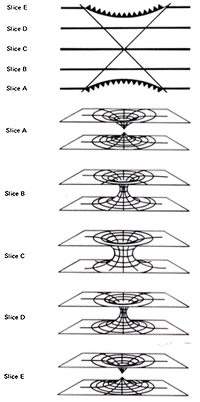 Spacetime slices of a static black hole7. |
I hope you've read up on spacetime diagrams and understand that bit about the singularity sometimes being a place and sometimes a time and the inertial frame bit, and Penrose diagrams and understand the whole wormhole thing.
The picture to the left shows an eternal static black hole, one that has existed from the beginning of time and will exist for all eternity. The first diagram shows the Penrose diagram for the black hole and below it are diagrams showing you how slices of the Penrose diagram would look. The slices are shown with 1 time dimension (in the vertical direction) and two spatial dimensions (in the horizontal directions). Okay, recall the lines of simultaneity? The surface of these graphs describes a plane of simultaneity. The 1-2 diagrams are known as embedding diagrams, for they take a slice of spacetime and embed it in the third dimension to show how it warps. It takes a lot of heavy calculation7 to create them and make such nice pictures as this one.
What does this picture mean? A, B, C, D, and E are slices of spacetime, you know that much. This picture chronologically follows the creation of a wormhole! That's a Star Trek:Deep Space 9 thing that allows you to travel from the Alpha quadrant to the Gamma quadrant and encounter the Founders and wage war for a few seasons. Or a Stargate thing that lets you explore the galaxy and fight the Goa'uld and the Wraith for many, many seasons. I could go on and on. Wormholes are a staple of science fiction.
Slice E shows spacetime beginning to pucker, D shows the wormhole bridging the two universes, C shows the shows the wormhole at its largest possible diameter, B shows the wormhole then pinching off, and A shows the resulting eternal spacetime. A is the future singularity, the thing everyone falls into; and B is the past singularity, the thing that theoretically spawned the universe. See how the bottom of the gravity well is so pointy? That point is the singularity. But, you say, there apparently are two singularities. Yes. One for our universe, one for another. This leads to slice B and D and C. The singularities are gone and the spacetime is connected! This would be the actual wormhole. Two universes or two places in one universe are "touching" in the sense that it is possible to go from one to the other. Incidentally, you'll notice that the embedding diagram looks a lot like a dip or a well in spacetime.
You'll see the term 'gravity well' to describe the region of spacetime warped by the gravity generated by the presence of matter. That just means the region of space where an object would feel the strong gravity of another object (Earth has a gravity well; the Moon has a smaller gravity well; and the Sun has a rather large gravity well).
This would be a great way to travel from place to place in the universe, except it is terribly unstable. The whole process of the wormhole forming and then pinching off sounds like it takes a while. Most astronomical stuff takes a while. Unfortunately, the wormhole pinches off so quickly that not even light can get through. A static black hole simply isn't meant for convenient space travel. A charged black hole's singularity looks like this in the sense that the singularity is pointy and nasty, but it has the virtue of avoidability.
What's so special about the ring singularity?
The singularity of a rotating black hole is different than that of a static or charged black hole. The Kerr geometry describes it as a ring, whereas the other two are points. As a result, it has some quirky properties. The oddest of which is not something I can prove to you right now. Some (nasty) calculations done by a C. T. Cunningham8 have proven that gravity around the ring singularity is repulsive. Light actually bounces away from it and things actually bounce off it! Well, not everything. It depends on your approach angle.
Remember how things were different along the equator of a rotating black hole? It's the same thing, again. Pretty much the only way to fall into a ring singularity is to approach it on the equatorial plane. All other approach trajectories will be repelled with increasing strength the closer the angle is to the axis of rotation. There is actually a third photon sphere right near the singularity. If light approaches nearly parallel to the axis of rotation, the gravity and antigravity of the singularity are balanced out; and the light traces out a funny-looking path of constant distance (which in Kerr geometry is an ellipsoid---a three dimensional oval). This path sometimes leads the light into another universe and back again.
That's why looking at a ring singularity is so much cooler than the other two singularities. Seen from the axis of rotation, it is a circular window with rings of different light. The larger the angle between your trajectory and the axis of rotation, the more oval that window becomes. Seen from the equator, it is a sort of line-like thing glowing with only one kind of light. What you actually see in the window can vary. Basically, you see three things: light from your own universe (from which you just came) that has been bouncing around the singularity, light from the singularity itself (it is such an odd place!), and light from the so-called negative space (however many other universes are visible from the black hole). Why does the singularity emit its own light? It's a place where events don't always follow a logical pattern (chaotic, remember?). Random particles are created and destroyed in the area just around it. That's why it would emit its own light.
Other universes
Why am I not describing those? According to one source, it's possible to peer in and see the light from 4 or 5 other universes and varying times. It's easier if you look at that Penrose diagram of the black hole. Theoretically, it goes on infinitely. You have access to an infinite number of universes from inside such a black hole. You could visit one, two, a few, or many! You could also weave in and out of the inner event horizon, peering at other universes and not entering them. That's why it's tough for me to give a general description of what you see past the singularity.
Talking about other universes can be ... awkward. Astronomers and physicists know that our universe turned out in a very nice way, with mostly matter rather than anti-matter, such that a planet like Earth could form and a clever species like humans could arise. There are debates about the Big Bang that created our universe and the nature of how universes could evolove. Simply put, just because things happened a certain way once by no means implies they'll happen that way often ... or even again. This makes complications for traveling to other universes ...
How to get from Universe A to Universe B in one piece
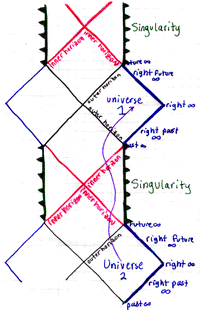 Penrose diagram of a rotating black hole showing multiple universes. |
To the right is the Penrose diagram for a charged or rotating black hole. One of the first things I want to point out is the nature of the singularity. I told you earlier that the singularity was a place in time; but that was only for the static black hole! See here, the singularity is a definite place, and places can be avoided as long as you don't have to go the speed of light to do it.
This is the road map for jumping from one universe to another. Say that purple worldline is me in my 2085 Ford Tempo rocket (with mismatching red paint). I want to travel somewhere using the super-massive rotating black hole right in front of me. I take the time to perch at the lip of the gravity well and at a small angle to one of the poles of the axis of rotation of the black hole. (My Tempo is impossibly well-shielded against radiation.) Armed with the might of relativity (and some auto insurance), I accelerate my Tempo towards the outer event horizon and dive into the 'well. As I fall, I'm trading gravitational potential energy for kinetic energy, and I end up going quite fast as I cross the outer event horizon. The instant I reach Rs, my engines cut off just as I preprogrammed them to do.
This particular galactic black hole is rotating very quickly, so I very quickly cross the inner event horizon. Since the two event horizons are nearly on top of one another and since I cut my engines before I entered the realm between them, I do not experience any tidal unpleasantness. A very curious thing happens when I cross the outer event horizon. The singularity becomes an unavoidable place in time---it becomes my future---as the time axis and the space axis of my spacetime diagram exchange places. As I cross the inner event horizon, time and space resume their normal axes on my spacetime diagram, and the singularity becomes a place in space.
I should remind you that I'm rocketing along at a speed close to light. I blaze across the inner event horizon and shoot right through the center of the ring singularity. Oooh, confusing statement. The singularity appears to me as a round window. If the singularity emits any light on its own, I would see that as the frame of the window. Inside that window...is reminiscent of what you see when you reflect one mirror into another: a hallway of mirrors arching into infinity. The smaller the angle between my approach and the axis of rotation, the more mirrors I see. What I see in the window of the singularity is the same; but, instead of mirrors, I see an infinite number of locations.
There is only one restriction on where I may go with a rotating black hole: to enter a black hole means to leave a black hole. Black holes are rather like subway terminals in that sense; if you walk down the stairs to take a train, you've got to walk back up the stairs when you exit. You can only exit at locations with those stairs. You could not use a black hole to pop out right next to earth, 1940, because there were no black holes right next to earth at that time.
I shoot through the very center of the window, nearly orthogonal to (perpendicular to) the window (nearly because I approached nearly parallel to the axis of rotation. I recross both event horizons, one after the other, and leave the black hole at a speed close to that of light. I gained all my speed entering the gravitational well, now I lose it all leaving the well. I coast away from the black hole's gravity well at the same speed I entered, the mirror-image of my worldline when I entered the gravity well --- which kinda means I end up perched at the lip of the gravity well, again, with the option to fall back in or to leave and explore.
This universe-jumping is a fun thing to think about, but I always get edgy when considering the idea of innocently wandering into a whole different universe. I mean, the only things that define our universe are our "laws" (axioms, theories --- as you please) of physics. The speed of light in a vacuum is 3x10⁸ m/s. Electrons have such and such weight and charge. The distribution of matter formed just after the big bang favored matter over antimatter (just). The universe expanded at such a rate that stars formed, some of which were conducive to the formation of planets. In another universe, the numbers for these laws might differ somewhat --- or the laws could be completely different! Recall all that dust and gas falling into the black hole as innocent little me attempts to leave the gravity well? Suppose the universe I just entered is one where antimatter is the dominant type of matter --- and here's little me and my rocket, made entirely of matter. Imagine my surprise as a tiny clump of anti-hydrogen atoms wisps against my Tempo's fender. Boom! Tremendous explosion and lots of energy released, and that's the end of my traveling days.
The other problem is that this situation is completely theoretical. The Kerr solution is very unstable. The mere approach of a rocket to the outer event horizon (let alone one diving across said horizon), will destabilize the black hole and make it fatal for the rocket attempting to travel through it. I'm sorry, it sounds like a fun way to explore, but that is the way things work.